/Feature
America is tempted by cheap Chinese clean tech. It should drive a harder bargain
The second-largest auto market in the world can set the terms for Beijing while also welcoming EVs and solar from Japan, Korea, India, and Europe.
A visit to Indonesia today paints a picture of fierce and diverse competition in the global electric vehicle market. In the capital of Jakarta, established Asian auto brands like Toyota, Mitsubishi, and Hyundai have long dominated the roads. More recently, brand-new BYD, Wuling, and Geely autos stand out among a faded older fleet of gasoline vehicles — but so too do a fair number of Hyundai Ioniqs, Vietnamese VinFast electric taxis, and even domestically made Indonesian Polytron EVs and Laksana electric buses.
To observers transfixed by China, such street scenes should signal an opportunity for the electric vehicle sector to diversify. Today, cutting-edge battery packs, rare-earth permanent magnets, refined battery chemicals, and component-manufacturing know-how all remain hard to acquire outside the Chinese industrial ecosystem. Jakarta suggests that need not last. Its streets are a testament to the efforts of other countries, like Japan and Korea, to assert their own clean-tech industrial power.
The United States should leverage its market size to encourage these diversification trends. A wider spread of manufacturing would advance U.S. interests, alleviating overconcentration in important supply chains and increasing the industrial capabilities available to American firms. But for now, U.S. elites seem fixated on China and BYD.
A recent op-ed by Brian Deese, former director of the National Economic Council under President Biden, described Chinese foreign investment as “the only way for the United States to catch up” in electric vehicles and energy storage.1 A like-minded piece by Johns Hopkins professor Jeremy Wallace similarly frames Chinese companies as the only force capable of modernizing American automaking.2
More vocal critics accuse U.S. automakers of scorning electric innovation and clinging to fossil-fueled cars,3 only to demand tariff protection now to save themselves from BYD and Geely’s gleaming new product lines.4 A similar narrative surrounds solar tariffs, which have grown U.S. solar manufacturing capacity but impose higher costs on grid-scale and home solar projects.5 “The tariffs are nuts,” opined Elon Musk early this year, alleging that “it would be much easier” to make his xAI data centers solar-powered without them.6 With each additional month of Hormuz-induced energy anxiety, more thinkers come to see Chinese EVs and solar panels as the panacea for abundant, affordable clean energy (and mobility) for U.S. consumers.7,8,9 “If the cars are produced in North America, it is hard to predict how cheap they would be, but I for one would like to find out,” writes UC Berkeley professor James Sallee.10 “American consumers are just missing out,” adds the Washington Post editorial board.11
But equating cheap clean tech with Chinese imports is both simplistic and shortsighted. A wider catalog of imported goods and a few final-assembly plants will not build the industrial ecosystem American manufacturers need to compete globally in electric vehicles and solar. The U.S. should leverage its status as the world’s second-largest auto market12 and third-largest solar market13 to lower barriers for producers in Japan, Korea, India, Southeast Asia, and Europe who are already competing hard — and to admit Chinese firms only on terms that keep global markets contestable.
The siren call to “just let the BYDs in” therefore amounts to poor strategy: insufficiently attentive to manufacturing ambitions beyond China, and too accepting of the asymmetries that skew competition. Many other countries, the U.S. among them, want a greater share of clean-tech growth sectors. American strategy should speed that diversification along rather than reinforce market overconcentration.

The world beyond China is already growing its clean-tech capacity
Many assume the U.S. faces a binary choice: welcome Chinese imports and industrial partnerships, or remain exiled on a fossil-fueled “island.”14 That framing ignores momentum in Europe and Asia that is likely to leave American consumers with plenty of clean-tech options. And diversification pays a double dividend: cheaper cars for everyday Americans now, and a more equitable, contestable global market that favors U.S. industry over the long run.
In the United Kingdom, the most affordable electric city cars predictably include entries from BYD and Leapmotor, but enthusiasts are also eyeing new electric models from Dacia, Renault, Honda, Nissan, Fiat, and Citroën.15,16 Japan significantly expanded EV purchase subsidies this year, doubling EV sales.17 Domestic “kei” mini-EVs like the Nissan Sakura are increasingly common sights on Tokyo roads, while Toyota, Daihatsu, and Honda are rapidly introducing new designs by electrifying some of their most popular gasoline models.18,19
Across Europe, Japan, Korea, and Southeast Asia, automakers are already responding to the rising wave of Chinese auto exports. Whether with better-value EVs from Toyota and BMW or dark-horse entries from Malaysia’s Proton and India’s Tata Motors, global manufacturers are fighting hard to win share in this growth sector. Vietnam’s VinFast even made a bold if messy effort to enter the U.S. market in 2023 with a target of more than a hundred dealerships,20 only to fall well short of its sales goals while delaying and scaling back its planned North Carolina factory.21
Such trends mean U.S. companies will face home-market pressure from lower-cost EVs regardless of the tariff fence against Chinese vehicles. The best way for U.S. policymakers to make imported EVs more affordable may be to cut auto tariffs specifically for non-Chinese manufacturers.
Under such a strategy, Americans could soon benefit from cheaper new models from European, Japanese, Korean, and other Asian manufacturers. Unfettered competition with Chinese exports could force American automakers and policymakers into a price war, matching Chinese industrial policy dollar for dollar; exposure to the wider electric vehicle market instead offers a better balance of protection and competition. Access to a U.S. market of more than 12 million new vehicles a year — one in six sold worldwide22 — would also make the global shift in auto trade less existential for Japan, Korea, and Germany, whose standing as automaking nations is under pressure from the same export wave.
Using American market power to push EV, battery, and solar manufacturing beyond China further serves American interests. A diversified market creates more upstream suppliers, more manufacturing technology, and more know-how that U.S. producers can tap free of Chinese IP restrictions and export controls. Other producers in Europe and Asia, moreover, cannot wield China’s concentrated market power and do not raise the same security or supply-chain opacity concerns.
“Using American market power to push EV, battery, and solar manufacturing beyond China further serves American interests. A diversified market creates more upstream suppliers, more manufacturing technology, and more know-how that U.S. producers can tap free of Chinese IP restrictions and export controls.”
In solar, the U.S. could similarly relax tariffs on imports from outside China, conditioning the lower rates on the use of non-Chinese metallurgical silicon, polysilicon, and wafers — the harder, more essential upstream inputs where diversification matters most. To date, Southeast Asian and Indian producers have largely imported wafers from China,23 with their factories performing only the simpler cell and module assembly steps. Yet ambitions run higher: India celebrated its first two-gigawatt wafer facility in 2025, and polysilicon and wafer manufacturers in Malaysia and Vietnam are expanding to double capacity by 2029.24,25 Tying market access to upstream integration would add momentum to these efforts. It would also ensure that whatever new competition U.S. solar manufacturers face comes from global peers building expertise across the whole supply chain, from silicon metal to finished module.
Washington’s working assumption should be that China’s current concentration of clean-tech expertise is transient. If solar cells, batteries, and EVs are really the rapidly evolving growth sectors of the future, then China will not manufacture 97 percent of the world’s solar wafers,26 90 percent of its graphite battery material, and 80 percent of its battery cells forever.27 Climate advocates now defend China’s surging solar and battery output as the well-earned result of visionary national policy.28,29 But that abundance came at the cost of manufacturing opportunities elsewhere,30 and with help from subsidies those same advocates would be slower to applaud — such as deeply discounted coal from state-owned enterprises for industrial heat and power.31,32 Spreading manufacturing know-how would accelerate technological progress; keeping so many supply-chain eggs in one national basket courts overconcentration risk.
“If solar cells, batteries, and EVs are really the rapidly evolving growth sectors of the future, then China will not manufacture 97 percent of the world’s solar wafers, 90 percent of its graphite battery material, and 80 percent of its battery cells forever.”
Critics will say the clean-tech market already operates at overcapacity, making it suicidal for new entrants to compete in batteries, solar, or electric vehicles. But economies like the United States, India, Japan, and the EU can’t afford to wait passively for the next favorable demand cycle to build expertise and industrial capacity. Battery active-material synthesis and solar wafer production are mastered through iteration and experience, not conjured from thin air. And failing to contest these industries today forecloses innovation in the next generation of technologies. Passivity now means stagnation later.
There is still a good deal to be made with China
The deal-makers are right about one thing: a negotiated opening to Chinese vehicle, battery, and solar manufacturers is possible, and it could serve American consumers well. Where they go wrong is in how little they ask for. A deal that pays over the long run has to advance diversification and give U.S. companies and workers the conditions they need to compete, and current commentary misses several of the components a contestable market requires.
Commentators correctly recommend that the U.S. condition market access on domestic manufacturing with high local employment, ensuring concrete economic opportunities for American communities and workers. The European Union, for instance, is weighing import-duty exemptions for Chinese auto brands in exchange for import price agreements and commitments to invest in relevant European industries with “clear, verifiable milestones.”33 Chinese automakers have already built or are building plants from Brazil to Hungary, Indonesia, Mexico, and Morocco — in Hungary, Brazil,34 and Indonesia35 directly because of tariffs — so such terms are a reasonable and increasingly common expectation.
Such proposals, however, underplay a second requirement: that Chinese factories source a meaningful share of upstream automotive components, battery cells, electronics, and raw materials from U.S. producers. These upstream inputs are precisely where Beijing guards industrial knowledge most fiercely and wields monopoly power most forcefully — so much so that venture investors now routinely deem battery and solar manufacturing “uninvestable” outside China.36 China’s tightening export controls on battery manufacturing technology,37,38 and the controls it has contemplated for solar,39 reveal a policy interest in constraining competitors worldwide — to say nothing of the direct restrictions on inputs like rare earths and graphite that have alarmed capitals from Brussels to Tokyo to Washington.40
Upstream sourcing provisions are what equip American industry to compete over the long term. Under such a deal, Chinese firms would have to either onshore earlier steps of the supply chain or buy those components from American suppliers; either outcome would transform U.S. manufacturing capabilities far more than assembly alone. Thanks to recent federal battery and EV incentive policies,41 much of the regulatory and compliance infrastructure for such local-content rules already exists. Without such requirements, domestic auto and solar plants would merely expand the customer base of Chinese cell and wafer producers, entrenching already lopsided market power. Factories that only perform final assembly will remain at a lasting disadvantage in designing the next battery pack or solar cell.
Debate to date has also neglected labor and supply-chain concerns that shape global market conditions. Negotiators should require Chinese manufacturers to make binding commitments to supply-chain transparency, labor, and environmental standards as a condition of market access. U.S. policymakers should expect Chinese firms to demonstrate global, company-wide compliance with the Uyghur Forced Labor Prevention Act before their products are considered for duty exemptions or federal subsidies.42 The United States–Mexico–Canada Agreement lays out a clear model for minimum wage thresholds and labor rights remedy mechanisms in the auto sector.43 Even Jeremy Wallace, whose Dissent essay looks to Chinese firms to modernize American automaking, proposes requiring union neutrality to ensure good wages, benefits, and representation.44
Such agreements could even be structured within a global framework that reciprocally includes European, Asian, and American automakers, lifting production norms across the sector worldwide. Despite years of effort by civil-society activists, governments, and corporate-responsibility professionals, the automobile and battery sectors still lack a binding supply-chain mapping and reporting requirement that reaches all the way to upstream suppliers and mined raw materials. Given its market size and regulatory precedents like the UFLPA and the Dodd-Frank Act’s conflict-mineral reporting provisions,45 the United States is uniquely well positioned to shape such a system.
To economists and policymakers, ethical sourcing may feel secondary to flashier issues like manufacturing localization and connected-vehicle security, but it is arguably integral to the future trajectory of industrial competitiveness. Clean-energy advocates may find the implications uncomfortable, but unconditional acceptance of Chinese EVs and solar modules overlooks real social risks. The status quo in these industries involves coal-fired industrial energy in Indonesia and northwestern China,46,47 conflict-mineral and forced-labor exposure in Myanmar and Xinjiang,48,49 and the exploitation of a Chinese workforce unable to unionize and often at the mercy of wage theft, deceptive hiring,50 and hazardous, dehumanizing factory conditions. BYD factory projects in Brazil and Hungary have themselves come under scrutiny,51,52 with authorities intervening to address the exploitation of overseas Chinese workers employed by construction contractors. Policymakers should treat access to the U.S. market as an opportunity to reaffirm better labor, social, and environmental norms, both at home and abroad.
Supply-chain transparency will matter more, not less, as time goes on. Refined materials make up the largest share of production costs in solar and battery cells53,54 — a share that has only grown as the cost of solar and battery equipment has fallen. As consumers and regulators demand cleaner steel or the exclusion of exploitative rubber producers, opacity should not be allowed to function as a competitive advantage.
Finally, a growing consensus holds that the U.S. government will need to enforce strict cybersecurity, data-security, and national-security safeguards on vehicles of Chinese make.55,56 Recent connected-vehicle incidents point to real risks. In Norway and Britain, transport authorities have raised concerns about over-the-air remote-access vulnerabilities in Chinese electric buses.57 This spring in China, Baidu self-driving robotaxis ground to a halt mid-operation across Wuhan,58 causing several accidents and stranding some passengers for up to 90 minutes. Even Chinese state media has acknowledged the geofencing and remote deactivation of vehicles, reporting on the manufacturer Zeekr’s revision of its policies after a car locked a customer out for 30 hours in Kazakhstan.59 Limits on remote access to vehicles and chargers, strong privacy protections, and requirements that usage and telemetry data be stored in the United States would protect American consumers and reduce risks ranging from criminal hacking to grid sabotage. The Chinese government, for its part, has enforced similar data-security provisions on foreign manufacturers like Tesla that sell cars within China.60
Any deal admitting Chinese clean technology into America will hinge on market-access terms that meaningfully strengthen U.S. industrial capabilities, diversify supply-chain bottlenecks, and affirm healthy standards for global competition. The United States should negotiate ruthlessly, aiming to extract the best possible deal from China in exchange for access to the second-largest auto market in the world. The terms of a good negotiation should be demanding enough to make BYD’s lawyers grit their teeth while still signing on the dotted line. China’s own well-practiced and meticulously prepared trade negotiators would expect nothing less.
“The United States should negotiate ruthlessly, aiming to extract the best possible deal from China in exchange for access to the second-largest auto market in the world. The terms of a good negotiation should be demanding enough to make BYD’s lawyers grit their teeth while still signing on the dotted line. China’s own well-practiced and meticulously prepared trade negotiators would expect nothing less.”
Import-dependency will always falter
The stakes of a U.S. market access deal extend beyond the price of a car or a rooftop array, or even the competitiveness of factories in Detroit and North Carolina. Trade terms that widen the manufacturing landscape make clean technologies easier to scale everywhere — and, in turn, deliver progressively cheaper EVs, batteries, and solar equipment to American consumers.
Electric cars and solar panels can reduce dependence on volatile flows of oil and gas. But China’s opaque, overwhelming shares of upstream steps like battery materials and polysilicon refining monopolize advanced manufacturing know-how and embed dependencies of their own. The insistence that durable, fuel-independent61 goods like EVs and solar panels are “worry-free”62 and don’t count as energy dependence on China63 misses the point. Countries prioritize energy security to minimize economic exposure to supply-chain disruption, to protect their geopolitical freedom of action, and to maintain their economic and industrial competitiveness.
Passive acceptance of mass Chinese clean-tech imports may deliver a narrow kind of energy security — freedom from oil and gas shocks — but inattention to diversification will sow the seeds of industrial non-competitiveness and trade vulnerability in the long run. Normalizing opaque Chinese production networks also imposes political commitments that make them increasingly inconvenient to challenge later. Such decisions can lock governments into trade with weak social safeguards: asked about human-rights risks in Chinese EV manufacturing, Canadian Prime Minister Mark Carney could only deflect that child and forced labor exist “around the world.”64
“Passive acceptance of mass Chinese clean-tech imports may deliver a narrow kind of energy security — freedom from oil and gas shocks — but inattention to diversification will sow the seeds of industrial non-competitiveness and trade vulnerability in the long run.”
A different approach makes it possible to balance industrial priorities with affordability for consumers. Policymakers should condition U.S. market access on terms that strengthen domestic manufacturing and level the playing field among producers, while using the scale of U.S. demand to accelerate the diversification of clean-tech markets. One of the best things that could happen for the long-term durability of clean technology worldwide — politically and technologically — would be to loosen its association with China alone. For years the United States has paid higher clean-tech prices out of a determination to own a share of the entire solar and battery verticals, and in doing so has created a semi-protected market for producers everywhere else. Alone among major economies in that willingness, America may yet do the world a service.

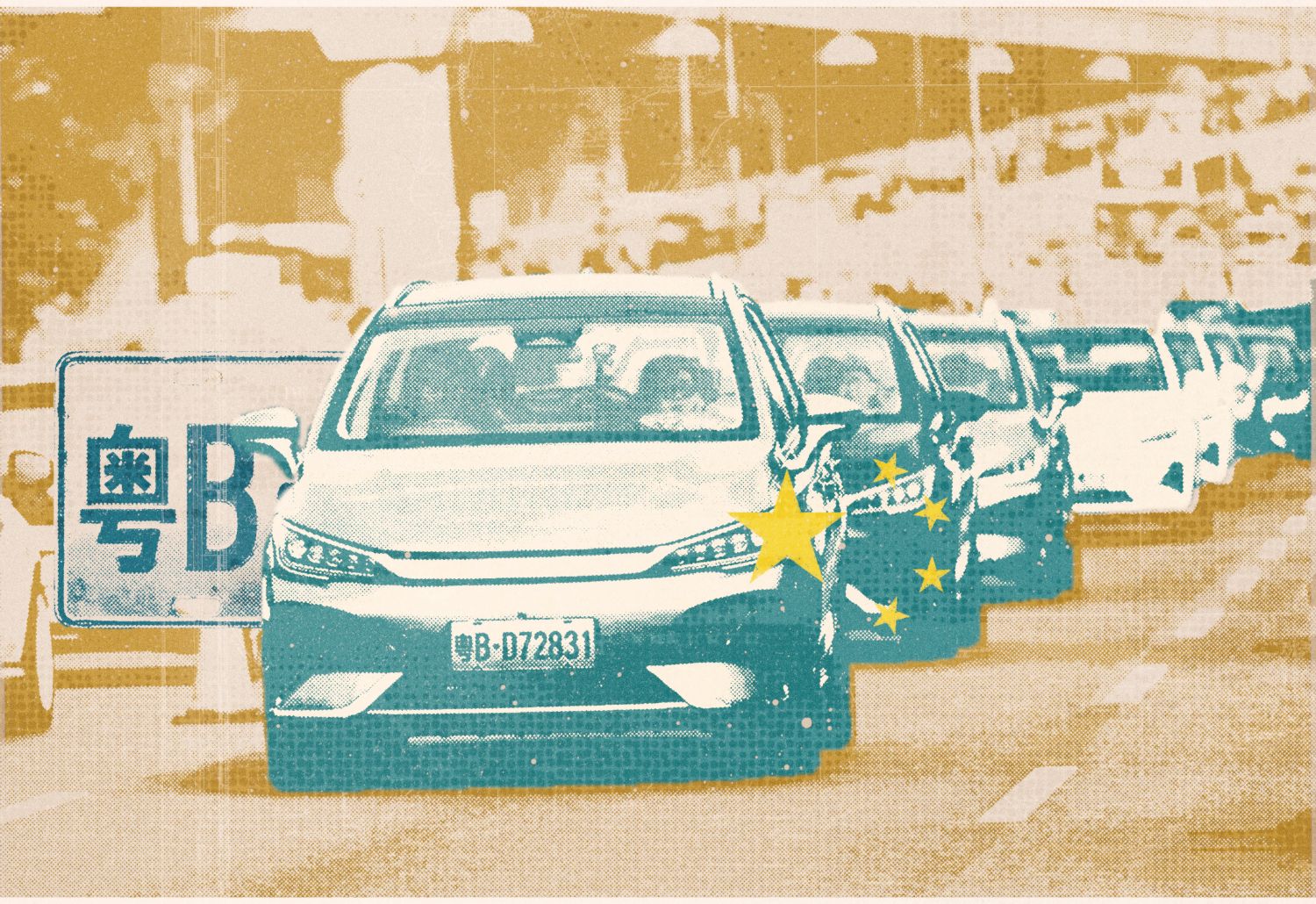
- 65Header image: Photo, Wuling Motors. Plate altered for editorial illustration.
- 1Deese, “The Case for Letting China In,” Foreign Affairs, September 10, 2026. https://www.foreignaffairs.com/china/case-letting-china-american-businesses-brian-deese
- 2Wallace, “China Takes the Wheel,” Dissent Magazine, September 2026. https://dissentmagazine.org/article/chinese-automakers-electric-vehicles-labor/
- 3Smith, “The Western (and Japanese) car industries are clinging to a dying, orphaned tech stack,” X, September 4, 2026. https://x.com/Noahpinion/status/2096026999953449288
- 4Fickling, “China Has Too Few EV Plants, Not Too Many,” Bloomberg Opinion, July 15, 2026. https://www.bloomberg.com/opinion/articles/2026-07-15/china-has-too-few-ev-plants-not-too-many
- 5“SEIA: US Now Manufacturing More Solar Panels Than It Installs,” RTO Insider, February 6, 2025. https://www.rtoinsider.com/97340-seia-us-manufacturing-more-solar-panels/
- 6Patel, “Elon Musk on Space GPUs, AI, Optimus, and his manufacturing method.” (interview with Elon Musk), Cheeky Pint, February 5, 2026. https://cheekypint.substack.com/p/elon-musk-on-space-gpus-ai-optimus
- 7Klein, “The China Shock 2.0” (interview with Brad Setser), The New York Times, August 21, 2026. https://www.nytimes.com/2026/08/21/opinion/ezra-klein-podcast-brad-setser.html
- 8Washington Post Editorial Board, “Trump Tariff on Chinese Solar Panels Will Raise Energy Costs,” Washington Post, August 8, 2026. https://www.washingtonpost.com/opinions/2026/08/08/trump-tariff-chinese-solar-panels-will-raise-energy-costs/
- 9Demsas, “Why Democrats and Republicans Want You to Pay $50,000 for a Car,” The Argument, May 21, 2026. https://www.theargumentmag.com/p/why-democrats-and-republicans-want
- 10Sallee, “The Electric Vehicle Tariff Boomerang,” Energy Institute Blog, UC Berkeley, March 2, 2026. https://energyathaas.wordpress.com/2026/03/02/the-electric-vehicle-tariff-boomerang/
- 11Washington Post Editorial Board, "China Already Sells Cars in the U.S. A Ban Would Hurt American Buyers," Washington Post, September 25, 2026. https://www.washingtonpost.com/opinions/2026/09/25/china-already-sells-cars-us-ban-would-hurt-american-buyers/
- 12International Trade Administration, “Automotive Industry,” SelectUSA. https://www.trade.gov/selectusa-automotive-industry
- 13SolarPower Europe, “New Report: Global Solar Market Hits New Record of 664 GW Installation in 2025, as Global Solar Fleet Passes 3 TW,” June 22, 2026. https://www.solarpowereurope.org/press-releases/new-report-global-solar-market-hits-new-record-of-664-gw-installation-in-2025-as-global-solar-fleet-passes-3-tw
- 66Electric and gasoline vehicles in Jakarta, Indonesia. Photo: Seaver Wang.
- 14Halveston, “How Collaboration with China Can Revitalize US Automotive Innovation,” Science, October 30, 2025. https://www.science.org/doi/10.1126/science.adz054
- 15“The CHEAPEST Electric Cars You Can Buy in 2026 (from £12k!),” What Car?, March 11, 2026. https://www.youtube.com/watch?v=UJQKkNVba34
- 16“NEW Honda Super-N vs BYD Dolphin Surf vs Citroen e-C3 Review – What’s the BEST Cheap Electric Car?,” What Car?, August 9, 2026. https://www.youtube.com/watch?v=lWPzfMZSlOU
- 17NHK World Japan, “EV Sales in Japan Double in First Half of 2026,” July 15, 2026. https://www3.nhk.or.jp/nhkworld/en/news/20260715_B3/
- 18Daihatsu, “Daihatsu Launches First Mass-Produced BEVs e-Hijet Cargo and e-Atrai,” February 2, 2026. https://www.daihatsu.com/news/2026/20260202-2.html
- 19Williams, “Honda’s Cutest EV Also Has Simulated Gear Shifting,” InsideEVs, April 11, 2026. https://insideevs.com/news/792677/honda-super-n-sale-uk/
- 20VinFast Auto Ltd., “VinFast Received 70 Dealer Applications Across U.S., with Plans to Expand to 125 Locations Nationwide,” press release, November 10, 2023. https://vinfastauto.us/investor-relations/news/vinfast-received-70-dealer-applications-across-us-with-plans-to-expand-to
- 21Dnistran, “VinFast Pushes Ahead With U.S. EV Plant Despite Industry Slowdown,” InsideEVs, August 2026. https://insideevs.com/news/790362/vinfast-us-factory-construction-restart/
- 22European Automobile Manufacturers’ Association, “Economic and Market Report: Global and EU Auto Industry Full Year 2025,” April 2026. https://www.acea.auto/files/Economic_and_Market_Report-Full_year_2025.pdf
- 23Federal Register, “Antidumping and Countervailing Duty Orders on Crystalline Silicon Photovoltaic Cells, Whether or Not Assembled into Modules,” August 23, 2023. https://www.federalregister.gov/documents/2023/08/23/2023-18161/antidumping-and-countervailing-duty-orders-on-crystalline-silicon-photovoltaic-cells-whether-or-not
- 24Press Information Bureau, Government of India, “India Achieves Historic Milestone in Renewable Energy Capacity Addition in FY 2024-25,” April 1, 2025. https://www.pib.gov.in/PressReleasePage.aspx?PRID=2117501&lang=2®=48
- 25“OCI to Boost Wafer Output by Thinning, Eyes Space Solar,” Sedaily, August 13, 2026. https://en.sedaily.com/finance/2026/08/13/oci-to-boost-wafer-output-by-thinning-eyes-space-solar
- 26International Energy Agency, “China’s Share in Global PV Manufacturing Capacity, 2024 and 2030.” https://www.iea.org/data-and-statistics/charts/china-s-share-in-global-pv-manufacturing-capacity-2024-and-2030
- 27International Energy Agency, “Manufacturing and Trade,” Global EV Outlook 2026. https://www.iea.org/reports/global-ev-outlook-2026/manufacturing-and-trade
- 28Buller and Merrick, “Introducing Issue #4: CHINA,” The Break—Down, September 7, 2026. https://www.break-down.org/introducing-issue-4-china/
- 29Weber, “China is backing strategic businesses, like green tech, while the west props up old sectors,” X, July 31, 2026. https://x.com/IsabellaMWeber/status/2083209168727466070?s=20
- 30“China Road Trip Exposes List of Uninvestable Assets in the West,” Bloomberg News, September 21, 2025. https://www.bloomberg.com/news/articles/2025-09-21/china-road-trip-exposes-list-of-uninvestable-assets-in-the-west
- 31OECD, “Measuring Distortions in International Markets: The Aluminium Value Chain,” 2019. https://www.oecd.org/content/dam/oecd/en/publications/reports/2019/01/measuring-distortions-in-international-markets-the-aluminium-value-chain_058cb425/c82911ab-en.pdf
- 32Xinjiang Uyghur Autonomous Region Ministry of Industry and Information Technology “电解铝企业自备电优势还能维持多久?” [How Long Can the Advantage of Self-Supplied Power Last in the Electrolytic Aluminum Industry], September 16, 2015. https://gxt.xinjiang.gov.cn/gxt/zdxxgk/201509/caadadfbb6254933a2e9549107775393.shtml
- 33European Commission, TRON case history, Case AS689. https://tron.trade.ec.europa.eu/investigations/case-history?caseId=2684#AS689
- 34“China’s BYD to Start Assembling Electric Cars in Brazil,” Investing.com/Reuters. https://www.investing.com/news/economy-news/chinas-byd-to-start-assembling-electric-cars-in-brazil-4124920
- 35Wijaya and Sinclair, “An EV-Fix for Indonesia: The Green Development-Resource Nationalist Nexus,” Journal of Contemporary Asia, 2024. https://www.tandfonline.com/doi/full/10.1080/09644016.2024.2332129
- 36“China Road Trip Exposes List of Uninvestable Assets in the West.”
- 37Ministry of Commerce of the People’s Republic of China, “商务部 海关总署公告2025年第58号 公布对锂电池和人造石墨负极材料相关物项实施出口管制的决定” [General Administration of Customs Announcement 2025 No. 58, Decision on Implementing Export Controls on Lithium Batteries, Synthetic Graphite Anode Materials, and Related Items], October 9, 2025. https://www.mofcom.gov.cn/zwgk/zcfb/art/2025/art_79646f0161564975a938fe00fee158d5.html
- 38Ministry of Commerce of the People’s Republic of China, “商务部、海关总署公告2025年第70号 公布暂停实施商务部、海关总署公告2025年第55号、56号、57号、58号及商务部公告2025年第61号、62号的决定” [General Administration of Customs Announcement 2025 No. 70, Decision Announcing Suspension of Announcements No. 55, 56, 57, 58, 61, and 62], November 7, 2025. https://www.mofcom.gov.cn/zwgk/zcfb/art/2025/art_b1ec77dd3f0d4762952904df7cdaadec.html
- 39Ng, “China’s Proposed Export Curbs on Key Solar Technologies Could Backfire, Hurt Domestic Giants, Analysts Say,” South China Morning Post, January 23, 2023. https://www.scmp.com/business/article/3208206/chinas-proposed-export-curbs-key-solar-technologies-could-backfire-hurt-domestic-giants-analysts-say
- 40Sadden, “FACTBOX: China’s Export Controls Weigh on Global Critical Minerals Supply,” S&P Global, September 10, 2026. https://www.spglobal.com/energy/en/news-research/latest-news/metals/090926-factbox-chinas-export-controls-weigh-on-global-critical-minerals-supply
- 41Federal Register, “Section 30D New Clean Vehicle Credit,” April 17, 2023. https://www.federalregister.gov/documents/2023/04/17/2023-06822/section-30d-new-clean-vehicle-credit
- 42Department of Homeland Security, “DHS Announces Addition of 43 Companies to UFLPA Entity List,” July 31, 2026. https://www.dhs.gov/news/2026/07/31/dhs-announces-addition-43-companies-uflpa-entity-list
- 43U.S. Department of Labor, Wage and Hour Division, “USMCA.” https://www.dol.gov/agencies/whd/usmca
- 44Wallace, “China Takes the Wheel.”
- 45Dodd-Frank Wall Street Reform and Consumer Protection Act, Public Law 111-203 (2010). https://www.govinfo.gov/content/pkg/PLAW-111publ203/pdf/PLAW-111publ203.pdf
- 46Centre for Research on Energy and Clean Air, “31 GW of Captive Coal Is Jeopardizing Indonesia’s Economic and Emissions Goals.” https://energyandcleanair.org/publication/31-gw-of-captive-coal-is-jeopardizing-indonesias-economic-and-emissions-goals/
- 47Wang, Lloyd, and Núñez-Mujica, “Sins of a Solar Empire,” The Breakthrough Institute. https://thebreakthrough.org/issues/energy/sins-of-a-solar-empire
- 48“Satellite Data Show Burst of Deforestation in Myanmar Rare-Earth Mining Hotspots,” Mongabay, September 2025. https://news.mongabay.com/2025/09/satellite-data-show-burst-of-deforestation-in-myanmar-rare-earth-mining-hotspots/
- 49Global Rights Compliance, “Risk at the Source: Critical Mineral Supply Chains and State-Imposed Forced Labour in the Uyghur Region,” June 2025. https://globalrightscompliance.org/wp-content/uploads/2025/06/GRC-critical-minerals.pdf
- 50China Labor Watch, “Forged in Silence: The Untold Stories of Chinese Workers at Indonesia’s Nickel Plants,” YouTube, June 28, 2024. https://www.youtube.com/watch?v=x0W1hotmIYs
- 51“Brazilian Prosecutors Sue Chinese Carmaker BYD Over Labour Conditions,” Al Jazeera, May 27, 2025. https://www.aljazeera.com/news/2025/5/27/brazilian-prosecutors-sue-chinese-carmaker-byd-over-labour-conditions
- 52“BYD EU Parliament Labor Abuse Hungary Factory Investigation,” CNBC, April 28, 2026. https://www.cnbc.com/2026/04/28/byd-eu-parliament-labor-abuse-hungary-factory-investigation.html
- 53Sun, Ouyang, and Hao, "Surging Lithium Price Will Not Impede the Electric Vehicle Boom," Joule, July 29, 2022. https://www.cell.com/joule/fulltext/S2542-4351(22)00302-6
- 54Chang, Newman, and Egan, "Future Cost Projections for Photovoltaic Module Manufacturing Using a Bottom-Up Cost and Uncertainty Model," Solar Energy Materials and Solar Cells, 2022. https://www.sciencedirect.com/science/article/abs/pii/S0927024821005651
- 55Smith, “Let the Chinese Cars In,” Noahpinion, January 26, 2026. https://www.noahpinion.blog/p/let-the-chinese-cars-in
- 56Chan, “A New Risk Framework for Chinese Technology Products and Investments,” Brookings, July 9, 2026. https://www.brookings.edu/articles/a-new-risk-framework-for-chinese-technology-products-and-investments/
- 57Van der Schyff and Corera, “It’s Not Where Buses Are Made, It’s How They’re Controlled,” The Strategist (ASPI). https://www.aspistrategist.org.au/its-not-where-buses-are-made-its-how-theyre-controlled/
- 58“Robotaxi Outage in China Leaves Passengers Stuck in Cars on Highways,” Wired. https://www.wired.com/story/robotaxi-outage-in-china-leaves-passengers-stuck-in-cars-on-highways/
- 59“Chinese EV Maker Zeekr Revises Cross-Border Policies After a Car’s Smart Features Were Locked Out for 30 Hours in Kazakhstan,” Global Times, July 26, 2026. https://www.globaltimes.cn/page/202607/1366852.shtml
- 60“Musk Visits Beijing as Tesla’s China-Made Cars Pass Security Rules,” CNBC, April 29, 2024. https://www.cnbc.com/2024/04/29/musk-visits-beijing-as-teslas-china-made-cars-pass-security-rules.html
- 61McKibben, “If the World Ran on Sun, It Wouldn’t Fight Over Oil,” The Guardian, September 18, 2019. https://www.theguardian.com/commentisfree/2019/sep/18/climate-crisis-oil-war-iraq-saudi-attack-green-energy
- 62“China Rules the Green Economy. Here’s Why That’s a Problem for Biden,” The New York Times, May 8, 2024. https://www.nytimes.com/2024/05/08/climate/china-us-podesta-liu.html
- 63Jones, “It’s not cool relying on China for sooo much of our clean tech,” X, November 8, 2025. https://x.com/CleanPowerDave/status/1987198937275465834?s=20
- 64Nadjibulla, “Canada-China Relations: Principled Pragmatism or Quiet…,” Asia Pacific Foundation of Canada. https://www.asiapacific.ca/publication/canada-china-relations-principled-pragmatism-or-quiet
About the author
Seaver Wang /@wang_seaver
Seaver Wang is the Director of the Climate and Energy program at the Breakthrough Institute, a non-profit environmental research center. His current research focuses upon minerals and manufacturing supply chains for low-carbon technologies, decarbonization of heavy industry, and on climate and energy policy in East Asia. Seaver holds a PhD in Earth and Ocean Sciences from Duke University. You can find him on X at @wang_seaver.