
/feature
America’s maritime policy is fighting the wrong war
The Jones Act spends its political energy on shipbuilding. The real maritime power game is somewhere else.
On March 18, 2026, the Trump administration did something it does not often do: it suspended one of the oldest protectionist laws on the American books. For sixty days, the Jones Act—the 1920 statute requiring that goods shipped between two U.S. ports travel on vessels built, owned, flagged, and crewed by Americans—would not apply to domestic oil shipments.1 The reason was simple. Foreign ships are cheaper than American ones, and the administration wanted to keep oil prices down.
The Jones Act has been waived before. It was suspended during World War II, when prosecuting the war took priority over protecting domestic commerce.2 Since then, notable waivers have expedited oil releases from the Strategic Petroleum Reserve in 1991 and 20113 and helped with relief efforts after Hurricanes Katrina, Harvey, and Fiona.45 But those were narrow, route-specific suspensions. The 2026 waiver goes further: it deregulates every domestic oil shipment at once, and it is the most significant waiver since the end of the Second World War.
That is a remarkable concession for a law its defenders insist is essential to American security and industry. But if the Jones Act is so critical, why does Washington keep waiving it whenever a real test arrives?
The honest answer is that the Jones Act has failed to deliver on its stated purpose, and the United States has fallen behind on nearly every metric that might measure maritime strength. America barely builds commercial ships anymore—just 0.04% of global output in 2024, behind Malaysia and Taiwan.6 The domestically flagged fleet has shrunk to 188 vessels.7 American share of global ship ownership is 1.89%.8 These are not the numbers of a maritime power.
Shipbuilding, however, continues to dominate American conversations on maritime power. It is what politicians campaign on, what lobbyists defend, what the White House's 2026 maritime action plan aims to revive. But shipbuilding is a scale business that long ago concentrated in East Asia, and the U.S. has essentially no chance of catching up without astronomical public investment. The real instruments of maritime power in the modern world—ship ownership, tax competition, flag attractiveness—are the ones where America could actually compete. Ship ownership is a real instrument of maritime power in the modern world that America could improve through tax competition. It is also one its current policy gets in the way of.
Shipbuilding
The most unusual aspect of the Jones Act is the domestic build requirement. Almost all maritime countries have some form of cabotage law (laws regulating the shipment between domestic ports), but America is almost entirely alone with its domestic build requirement.9
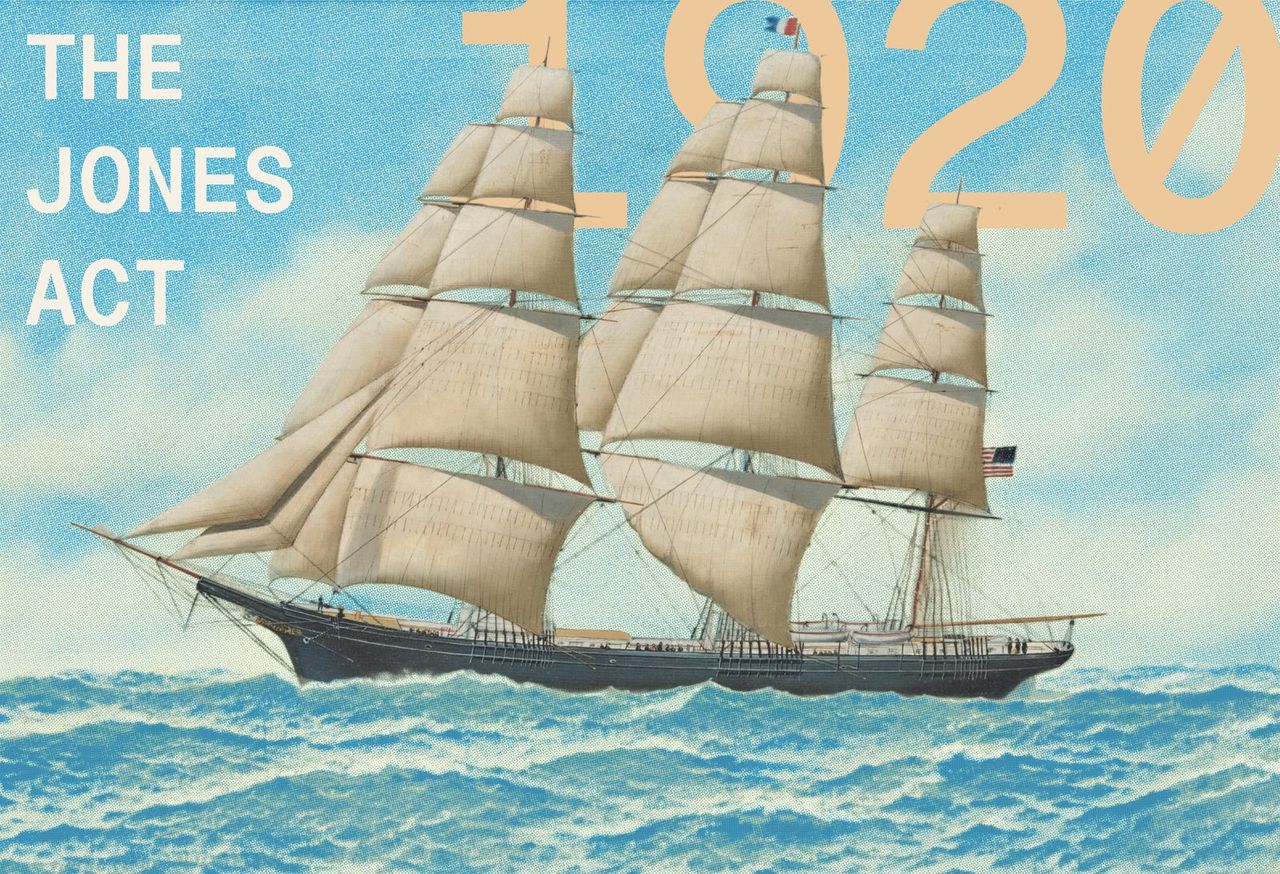
The country was once a leading shipbuilding nation. American yards supplied Britain with one-third of its merchant ships by the time of the American Revolution,10 and after independence, American shipwrights ushered in the age of the clipper (a cargo ship optimized for speed) during what is often called the golden age of American shipbuilding.11
Most commentary on America's shipbuilding decline focuses on the last few decades, or on the period since World War II. But the true decline began after the American Civil War.12 Ships were transitioning from sail and wood to steam and steel, and America lagged behind. British steel was cheaper than American steel, and American shipbuilders were slow to retool.
The decline persisted into the twentieth century, except during the World Wars, when ship production briefly exploded.13 The Jones Act was passed in the wake of World War I, in an attempt to lock in those wartime gains and strengthen the American maritime industry through regulatory protection. It did not work. After the Second World War, the same pattern repeated: a wartime surge followed by a peacetime slump. The removal of shipbuilding subsidies in the 1980s hastened a decline that was already well underway, and American shipbuilding transitioned from being a small share of global production to being virtually non-existent. America produced just 0.04% of the world's commercial ships in terms of gross tonnage in 2024.14 That puts America just ahead of Norway and Romania and just behind Malaysia and Taiwan.
Meanwhile, shipbuilding concentrated in Asia. Yards there adopted the modular production techniques that America had pioneered during World War II but abandoned afterwards. China, South Korea, and Japan grew from producing barely any of the world's commercial ships in terms of gross tonnage to producing 54.6%, 21.0%, and 12.6% respectively.15 East Asian dominance in shipbuilding is virtually unassailable at this point. Shipbuilding benefits from massive economies of scale—the more ships a yard builds, the cheaper it is to build each one—and that scale has now long since concentrated on the other side of the Pacific.
American shipbuilding has also been heavily protected throughout its history. When Americans had abundant access to critical inputs like timber, regulatory protection had little impact on American shipbuilders. Once ships were built with steel, however, the protected industry faced less pressure to adapt. Subsidies, tariffs, and the regulatory precursors to the Jones Act (and then the Jones Act itself) gave American shipbuilders a captive market and insulation from the competitive forces that drive efficiency. The protection worked, in the narrow sense that it kept domestic yards in business. It also produced an industry that cannot compete in any market where it is not guaranteed customers.
So why keep trying?
Shipbuilders and politicians insist that America's domestic commercial shipbuilding capacity is critical to America's national defense. The argument has intuitive appeal. A country cut off from foreign suppliers in wartime would presumably want a standing capacity to build its own ships. But the argument does not survive contact with the facts.
Start with the supply chain. Jones Act ships are built in America only in the sense that they are assembled in America. As of April 2025, no ship in the Jones Act fleet had an American-made engine built since 2000, an American propeller since 2010, or an American anchor since 1998.16 Not a single vessel had an American-built generator. Building commercial ships domestically is not enough to insulate America from foreign markets, because the inputs to domestic shipbuilding come from foreign markets. The White House's 2026 maritime action plan has pushed for more American-built components,17 but that would only drive up the price of Jones Act ships even further relative to the rest of the world.18
There is also no real relationship between the production of commercial ships and military ships. Keeping the remains of America's commercial shipbuilding industry on life support could possibly have some merit if it was useful for producing military ships. If commercial shipbuilding had production synergies with naval shipbuilding, the cost of inefficient commercial shipyards would be partially offset by lower costs in ramping up naval production in a time of war.
Alas, such synergies do not exist. There are major differences between commercial and naval shipbuilding that undercut any potential benefit of commercial shipbuilding as a dual-use industrial base.19 This is not unique to America. Mitsubishi Heavy Industries, a Japanese company that engages in both commercial and naval ship production, keeps its two operations "physically and organizationally 'air gapped' from each other."20 Expanding commercial shipbuilding may even put a strain on military shipbuilding, as both industries compete for the same kinds of workers.21
If Congress removed only the domestic build requirement of the Jones Act, Americans would suddenly be able to buy commercial ships from allies at globally competitive prices. South Korea and Japan, the second and third largest shipbuilding nations in the world, would be obvious partners. The size of the American fleet engaged in cabotage would grow. In a war or some other crisis requiring a major sealift operation, there would be a larger fleet in domestic use ready to be diverted. Shipping prices would fall. American markets would become more integrated.
American shipbuilders that could not compete would go out of business. That would not be the end of the world, or even put America at serious risk. In the short run, the country could fall back on its imported cabotage fleet for support. If the United States were somehow cut off from global shipbuilding markets for an extended period of time—an unlikely proposition—it would have to rebuild its shipbuilding industry from scratch. But that is barely different from today's state of affairs. America's domestic shipbuilding capacity is already terribly inefficient and barely produces any ships. The shipbuilding capacity kept 'alive' by the Jones Act is nowhere near worth the cost the Jones Act imposes to keep it that way.
Flagging
If shipbuilding is the war American policy cannot win, flagging is the war it has priced itself out of. Only about 1% of American foreign trade is carried on U.S.-flagged ships.22 The reason is simple: flying the American flag is expensive, and the expense is mostly labor.
A ship's crew must be at least 75% American citizens, and American crews are considerably more expensive than foreign crews. A 2011 report by the U.S. Department of Transportation Maritime Administration found that crew costs for U.S.-flagged ships were 5.3 times the average crew costs for foreign ships.23 Those high crew costs drove higher operating costs: U.S.-flagged ships' operating costs were 2.7 times foreign operating costs, and crew costs made up 68% of U.S. operating costs, while they made up only 35% of foreign operating costs.
The problem has likely only gotten worse since that report was published. The United States is facing a shortage of merchant mariners, with no end in sight.24 A simple partial fix would be to weaken the crew requirements for Jones Act and U.S.-flagged ships. The crew requirements could be dropped altogether, or changed to require a lower share of the crew to be American. Even an aggressive reform may not be enough on its own: France requires only 25% of its ships' crews, along with the captain and chief mate, to be from the European Union, and it is still facing mariner shortages.2526 Crew nationality requirements in flagging regulations increase operating costs, which in turn make a flag undesirable.
Flagging requirements give governments regulatory influence over the ships that fly their flag, but at the cost of discouraging ships from flying it. Governments that impose burdensome requirements therefore have to provide offsetting incentives to attract shipowners. That can be a fine trade off, but it has its limitations. The more burdensome the regulation, the more expensive it is to attract ships to the flag. Governments have to weigh the regulatory influence they gain against the cost of maintaining a fleet under it.
The United States has come down heavily on the side of burdensome regulation, and it pays the price accordingly. Cargo preference laws require that at least 50% of civilian agencies and agricultural cargo, and 100% of military and Export-Import Bank cargo, be carried on U.S.-flagged ships.27 The Maritime Security Program (MSP) and Tanker Security Program (TSP) are subsidy programs that pay stipends to U.S.-flagged cargo and tanker shipowners in exchange for making their ships available to meet the needs of the American government in times of war or crisis. Together, these programs bring the U.S.-flagged fleet to 188 ships as of 2025,28 with 93 in the Jones Act fleet and 95 in the non-Jones Act fleet.29
That is what a century of regulatory protection and subsidy has produced. Compare it to the top five flags of convenience—Liberia, Panama, the Marshall Islands, Hong Kong, and Singapore—which together carry 60% of the world's shipping capacity. Those jurisdictions understood the basic logic of flagging early: make it cheap and easy to register a ship, and ships will come. Ships began flying flags of convenience in the twentieth century precisely because the old correspondence between a ship's flag and its owner, maker, or crew had broken down. Flagging vessels is now a globalized system. It cannot be a mechanism for both widespread influence and serious control. The American government has opted for a high degree of control, which has imposed serious, and often unnecessary, costs on its citizens.

Ownership
There is one area of maritime power where the United States has not fallen behind. It is also an area American policy ignores.
America produces 0.04% of the world's commercial gross tonnage. Americans currently own 1.89% of global shipping in terms of dead weight tonnage.3031 The gap between production and ownership is even more striking in China. China (including Hong Kong) built 54.6% of the world's shipping in gross tonnage terms, but owns only 20.1%. China builds 1,271.1 times as much shipping as the United States, but owns only 10.6 times as much. If the United States wants to compete with China in shipping,32 ownership is a considerably more viable strategy than shipbuilding, particularly once the economies of scale that have already concentrated in East Asia are accounted for.
Greece has taken the ownership strategy to its extreme. Greek yards built no ships in 2024, but Greek owners control 16.43% of global commercial shipping by dead weight tonnage (almost nine times the American share!) and 88% of Greek-owned ships sail under a foreign flag. Greece has a considerable fleet flying its flag, but its true maritime influence comes from ownership.
Greece owns so much of the world's shipping in large part because its tax system is built to encourage it. Greece imposes a light tonnage tax on Greek-owned ships. Under Greek law, "payment of tonnage tax exhausts any further tax liability with respect to any tax, tax duty, contribution or withholding tax for foreign-sourced income arising from the ship's exploitation, not only for the shipowner company, but also for the bareboat charterer company, the ship lessee company or the company owning the ship under a foreign flag and managed by offices or branches or companies established through the provisions."33 In other words: one light, ship-specific tax, and the economic activity of the ship is exempt from everything else. For a highly valuable, highly mobile asset class like commercial shipping, a regime like that is appealing, to say the least.
Ship ownership is the perfect environment for tax competition; jurisdictions ought to compete in attracting capital by lowering their taxes on that capital. Commercial ships are extremely valuable and highly mobile, and therefore should be very responsive to differences in tax regimes. If America streamlined its tax system to resemble Greece's, i.e. by implementing a simple tonnage tax on American-owned ships that removes any other tax liability from the ownership, operation, or sale of the vessel, it could expect to take control over a larger share of the world's shipping. The tax burden for ship ownership would become simple, light, and attractive to American investors. That would give American-owned ships an advantage over those registered in higher-tax jurisdictions and make them competitive with other low-tax jurisdictions like Greece.
The United States already has the institutional machinery for this kind of bet. Of the 100 largest companies in the world by value, fifty-nine were American, and sixty-five percent of the combined market value of the top 100 companies was American.34 Overall, America has created a friendly environment for businesses to grow through generally light taxes and relatively easy regulations. If the U.S. government applied those same principles to ship ownership by streamlining the tax system to resemble that of Greece, America would take up a more prominent position in the global shipping industry.
What America could actually pass
In an ideal world, the Jones Act would be scrapped entirely. But we live in a world where powerful lobbies hold sway over influential lawmakers, and outright repeal is not on the table. America's best realistic hope is to reduce the regulatory protection of the maritime industry to match the protections employed by most other countries.
That would not take much. Get rid of the domestic build requirement in the Jones Act, lower the percentage of mariners required to be American, and lower and simplify the tax code for merchant ships. These three changes would swell the number of ships in America's domestic maritime trade, flying the American flag, and owned by Americans.
The Trump administration's sixty-day waiver will provide temporary relief. When it expires, America will be right back where it started: a country that built its maritime policy around an industry it lost, ignored the industries it could still win, and kept paying the bill for both.

- 1PBS News, "What to Know about the Jones Act as the Trump Administration Unveils a 60-Day Waiver," March 18, 2026, https://www.pbs.org/newshour/politics/what-to-know-about-the-jones-act-as-the-trump-administration-unveils-a-60-day-waiver.
- 2Charlie Papavizas, "Jones Act Waivers and Hurricanes," MaritimeFedWatch (Winston & Strawn LLP), 2024, https://www.winston.com/en/blogs-and-podcasts/maritime-fedwatch/jones-act-waivers-and-hurricanes.
- 3John Frittelli, "Shipping under the Jones Act: Legislative and Regulatory Background," Congressional Research Service, November 21, 2019, https://www.congress.gov/crs-product/R45725.
- 4"Waivers of Jones Act Shipping Requirements," EveryCRSReport, 2017, https://www.everycrsreport.com/reports/IN10790.html.
- 5Demian Brady and Atticus Vernacchio, "The Jones Act Paradox: Why Is a Law That Is Deemed 'Essential' so Frequently Waived?" National Taxpayers Union Foundation, 2023, https://www.ntu.org/foundation/detail/the-jones-act-paradox-why-is-a-law-that-is-deemed-essential-so-frequently-waived.
- 6UN Conference on Trade and Development, "Data Hub," 2025, https://unctadstat.unctad.org/datacentre/dataviewer/US.ShipBuilding.
- 7United States Department of Transportation, "Number and Size of the U.S. Flag Merchant Fleet and Its Share of the World Fleet," n.d.
- 35Bethlehem-Fairfield Shipyards, Baltimore, Picryl Public Domain Media, via picryl.
- 8UN Conference on Trade and Development, "Data Hub," 2025, https://unctadstat.unctad.org/datacentre/dataviewer/US.FleetBeneficialOwners.
- 9United States Maritime Administration, "By the Capes around the World: A Summary of World Cabotage Practices," 1990, https://rosap.ntl.bts.gov/view/dot/15947.
- 10United States Maritime Commission, "Merchant Marine for Trade and Defense" (Washington: Division of Public Information, United States Maritime Commission, 1946).
- 11Theodore A. Wilson and John Alan Ross, "Clipper Ship Era," EBSCO Research Starters, 2023, https://www.ebsco.com/research-starters/history/clipper-ship-era.
- 12Andrew Gibson and Arthur Donovan, The Abandoned Ocean (Columbia: University of South Carolina Press, 2000), 4–5, 62, 72.
- 13Brian Potter, "How the US Built 5,000 Ships in WWII," Construction Physics, May 7, 2025, https://www.construction-physics.com/p/how-the-us-built-5000-ships-in-wwii.
- 14Colin Grabow, "Protected US Shipbuilding Continues to Sink," Cato Institute, 2025, https://www.cato.org/blog/protected-us-shipbuilding-continues-sink.
- 15Grabow, "Protected US Shipbuilding Continues to Sink."
- 36The Clipper Ship Flying Cloud, Antonio Jacobsen, MutualArt, via Wikimedia Commons.
- 16Caleb Petitt, "Jones Act Parts Dataset: Where Ships Really Come From," Independent Institute, April 9, 2026, https://www.independent.org/article/2026/04/07/jones-act-parts-dataset-where-ships-really-come-from/.
- 17The White House, "America's Maritime Action Plan" (Washington: The White House, 2026), https://www.whitehouse.gov/wp-content/uploads/2026/02/Restoring-Americas-Maritime-Dominance.pdf.
- 18Caleb Petitt, "The Trouble with Trump's Maritime Action Plan," Independent Institute, March 15, 2026, https://www.independent.org/article/2026/03/15/the-trouble-with-trumps-maritime-action-plan/.
- 19Thomas McKenney and Emma Pettigrew, "A Unified Vision for U.S. Maritime Power," Great Lakes Maritime Institute, University of Michigan, 2025, https://maritime.engin.umich.edu/wp-content/uploads/sites/697/2025/10/GLMI.A.Unified.Vision.Whitepaper.pdf.
- 20Jeong Soo Kim, "Lessons from Japan and South Korea's Submarine Builders," U.S. Naval Institute Proceedings, June 2025, https://www.usni.org/magazines/proceedings/2025/june/lessons-japan-and-south-koreas-submarine-builders.
- 21Colin Grabow, "Washington's Misplaced Shipbuilding Obsession," CIMSEC, January 28, 2026, https://cimsec.org/washingtons-misplaced-shipbuilding-obsession/.
- 22John Frittelli, "Cargo Preferences for U.S.-Flag Shipping" (Washington: Congressional Research Service, 2015).
- 23U.S. Department of Transportation Maritime Administration, "Comparison of U.S. and Foreign-Flag Operating Costs," 2011.
- 24"U.S. Merchant Mariner Shortage Demands Action Now," gCaptain, September 22, 2024, https://gcaptain.com/op-ed-u-s-merchant-mariner-shortage-demands-action-now/.
- 25French International Register, "Nationality Criterion on Minimum Safe Manning," October 12, 2022, https://www.rif.mer.gouv.fr/nationality-criterion-on-minimum-safe-manning-a418.html?lang=en.
- 26Gautier Demouveaux, "Le secteur de la marine marchande en mal d'aspirants à la formation," Centre Inffo, November 23, 2022, https://www.centre-inffo.fr/site-centre-inffo/actualites-centre-inffo/le-quotidien-de-la-formation-actualite-formation-professionnelle-apprentissage/articles-2022/le-secteur-de-la-marine-marchande-en-mal-daspirants-a-la-formation.
- 27U.S. Department of Transportation Maritime Administration, "Cargo Preference," 2025, https://www.maritime.dot.gov/ports/cargo-preference/cargo-preference.
- 28United States Department of Transportation, "Number and Size of the U.S. Flag Merchant Fleet and Its Share of the World Fleet," n.d.
- 29U.S. Department of Transportation Maritime Administration, "United States Flag Privately-Owned Merchant Fleet Report," April 2025, https://www.maritime.dot.gov/sites/marad.dot.gov/files/2025-07/DS_USFlag-Fleet_2025_APRIL.pdf.
- 30UN Conference on Trade and Development, "Data Hub," 2025, https://unctadstat.unctad.org/datacentre/dataviewer/US.ShipBuilding.
- 31UN Conference on Trade and Development, "Data Hub," 2025, https://unctadstat.unctad.org/datacentre/dataviewer/US.FleetBeneficialOwners.
- 32Michael Roberts, "America's Maritime Wake-up Call: Competing with China at Sea," Hudson Institute, January 8, 2026, https://www.hudson.org/national-security-defense/americas-maritime-wake-call-competing-china-sea-michael-roberts.
- 33Iason Skouzos TaxLaw, "Overview of the Shipping Tax Regime in Greece," July 3, 2023, https://www.taxlaw.gr/en/practice-areas/tax-law/overview-of-the-shipping-tax-regime-in-greece/.

About the author
Caleb Petitt /@CalebDPetitt
Caleb Petitt is a research associate at the Independent Institute in Oakland, California. He graduated with a PhD in Economics from George Mason University. His research focuses on the historical political economy of the Atlantic economies in the Early Modern Period. He is also interested in the economics of international trade and Smithian Political Economy. You can be find him on X at @CalebDPetitt.